
Orange Forum 2025: The Global South Takes the Lead
The trading floor of the Indonesia Stock Exchange filled with almost 500 in-person and online participants from more than 32 countries on the morning of November 17 in Jakarta. IIX CEO and Founder Prof. Durreen Shahnaz stood alongside Bappenas Vice Minister Febrian Alphyanto Ruddyard, IDX President Director Iman Rachman, and PT PNM’s Commissioner Veronica Colondam. In their hands: a ceremonial bell.
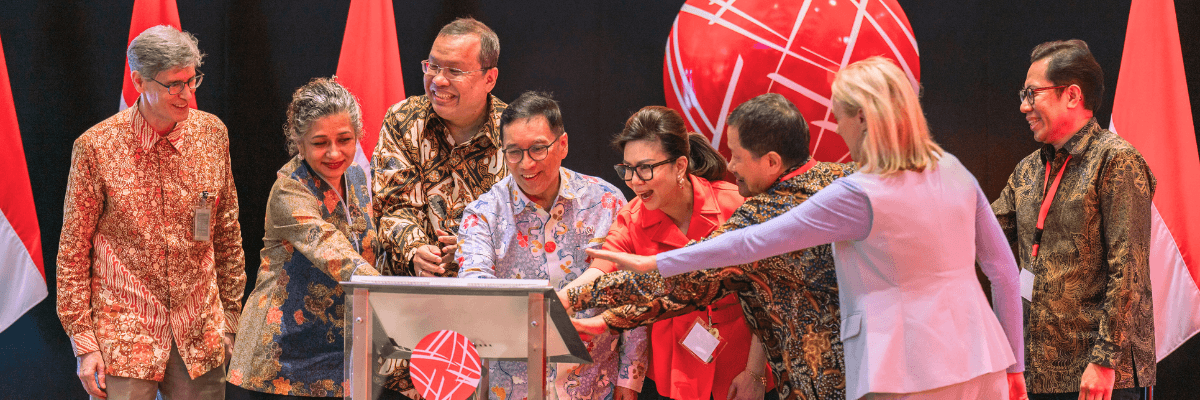
Its ringing symbolized Indonesia’s leadership in a financial movement reshaping how the Global South builds prosperity. The ceremony celebrated Indonesia’s first Orange Bond and the world’s first Orange Sukuk, instruments that embed gender equality and climate action into capital markets.
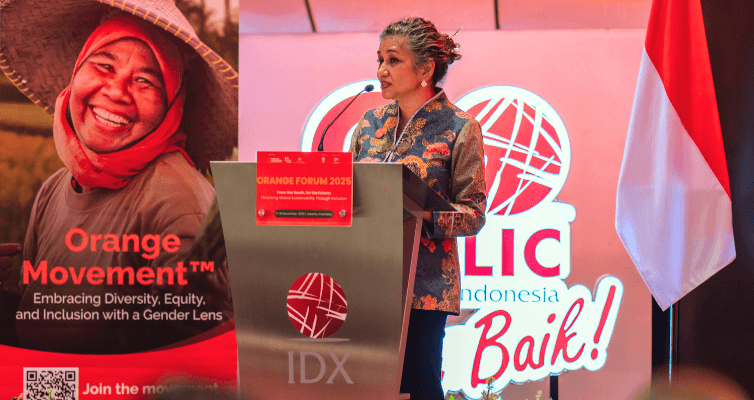
Earlier that morning, Prof Durreen Shahnaz outlined the stakes. “Top down, grant-dependent, post-World War 2 approaches are now antiquated and cannot solve the multilayered problems of a globally connected world we now live in,” she said. For decades, rules governing sustainable finance were set thousands of miles away from affected communities.
She posed key questions that would guide the day’s panels: “Finance for good, but good for whom? Climate action, but for whom?”
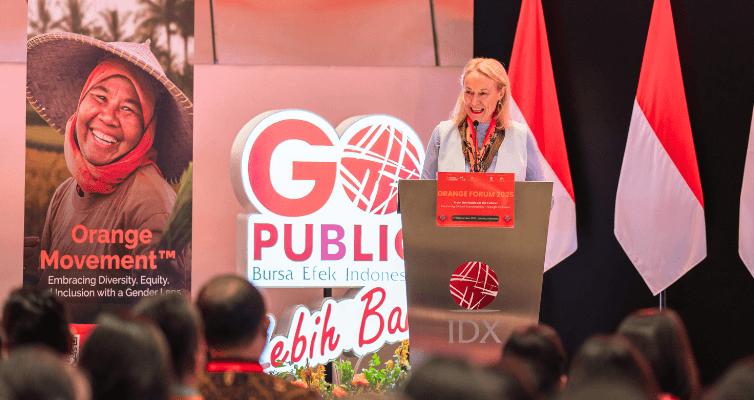
Dr. Sarah Pearson, inaugural chair of the Orange Movement, opened the forum with a challenge to centuries of financial exclusion. “For about 700 years, capital markets were designed to serve a very narrow segment of society,” she said. “Women, indigenous peoples, and underserved communities were rarely at the decision-making table.” She rejected the deficit model: “This is not about being nice. It’s about being smart. Women deliver investable return on investment solutions.”
The evidence supports this. Countries with more women in parliament are more likely to ratify environmental treaties. Peace agreements that include women are 35% more likely to endure for at least 15 years. Advancing women’s employment could add $12 trillion to global GDP. “Gender equality is one of the most reliable predictors of long-term growth,” Dr. Pearson noted. “The question is how do we turn what we know into something that markets can act on?”
Orange Bonds provide that mechanism, representing the world’s first cross-cutting asset class investing in women, marginalized communities, and climate resilience. In three years, $1.5 billion has been committed across Indonesia, Japan, Singapore, Australia, and the United States. Over 293,000 people across six continents have signed the Orange Pledge. Indonesia now hosts the country’s first Orange Bond and the world’s first Orange Sukuk.
Impactful Dialogue at the Forum
Through wide–ranging thematic sessions, practitioners across the region showed how the Global South is rewriting sustainable finance through work already underway, when communities lead, and when inclusion is prioritized.
Indonesia Sets the Regional Blueprint
This spotlight positioned Indonesia as the region’s blueprint for sustainable finance — pioneering multiple first-in-Asia thematic instruments and developing enabling regulatory frameworks through the Government and regulatory bodies such as the Indonesian Finance Authority (OJK) and the Indonesia Stock Exchange (IDX). Speakers discussed taxonomy alignment, disclosure standards, anti-greenwashing safeguards, and fiscal incentives to encourage wider sustainability bond issuance.
The panel framed inclusive growth beyond GDP metrics, challenging policymakers to ensure market expansion benefits women, MSMEs, rural communities, and those historically outside financial reach. Indonesia shared how SDGs were mainstreamed into national development policy and financing frameworks, enabling sovereign issuance of Orange, green, SDG, and blue bonds. “We mainstream SDGs into our national plan because development cannot rely on the government alone,” said Deputy Minister of Indonesian Ministry of National Development Planning, Leonardo Teguh Sambodo.
Power from Data
The “Turning Risk into Resilience” panel examined how data determines access to finance. Global South nations need to control their own data infrastructure and AI design. Indonesia presented its One-Data architecture as foundational infrastructure. Media-driven ESG indices create public accountability. AI-enabled credit scoring has given farmers and women entrepreneurs financial visibility where they previously had none. Those who appear in the data can better access finance. But data alone doesn’t move capital. It needs to work in tandem with Policy action.
From Policy to Implementation
The “Enabling the Shift” panel showed how Indonesia mainstreamed SDGs into national development plans, enabling sovereign issuance of Orange, green, SDG, and blue bonds. The panel examined growth beyond GDP, including how market expansion reaches women, MSMEs, and rural communities. Market regulators and bond issuers are working together to advance sustainable capital forward. Key takeaway from the discussion is how inclusion can drive capital efficiency, and when implemented and safeguarded by policy, both will thrive.
Making the Business Case for Inclusion
The “Business of Inclusion” panel examined how companies hire, train, compensate, and source across their operations. Evidence showed that inclusion improves margins, stability, and supply-chain resilience in climate-vulnerable sectors where women dominate agricultural and micro enterprises, scaling all the way up to national productivity and economic growth.
“You cannot scale empowerment if you cannot measure it,” one panelist said. Measurement frameworks remain incomplete. Companies need better tools to align operations with gender-responsive growth.
Building Infrastructure For and From Communities
The “Financing the Real Economy” panel examined how physical infrastructure development, including water and climate-resilient projects, has the potential to drive inclusive development by integrating community and women considerations into the project value chain.
“Gender integration determines whether a project survives once built,” said Charlotte Camille Chow Turk, Director of Gender and Social Inclusion at Global Green Growth Institute (GGGI). Community stewardship and women-driven engagement improve project longevity, creditworthiness, and development returns, while also helping unlock more inclusive capital, highlighting Orange as a cross-cutting green-infra asset class.
The Architecture of an Investable Ecosystem
A technical panel addressed underwriting mechanisms, legal certainty, disclosure standards, and regulatory architecture. Bangladesh and Indonesia shared how their markets are evolving from isolated pilot instruments to sustainable finance ecosystems. Participants emphasized the role of risk-sharing models, blended finance, and guarantees. The most significant signal from the room: Orange is no longer conceptual, it is now investable.
Orange in Practice
The closing plenary proved a powerful point: Orange is action, not theory. The panel brought together real-world practitioners, from PNM pioneering the IDR 16 trillion ($980 million) orange capital program to IDX and OJK working on an enabling policy environment, and Development Finance Institutions’ guarantees enabling $288 million in capital for grassroots impact across four continents.
One panelist captured the challenge with a football metaphor: financial systems are like playing on a hillside where one team always starts at the bottom. “That is the reality when women are asked to navigate systems with barriers we think are normal but aren’t,” the panelists said.
The panel discussed how to level the field by breaking silos between green and orange financing. One panelist connected equality in the financial access playing field to peace: “Human capital is needed for this transition and we cannot exclude 50% (women),” the panelist said.
The closing statements were urgent. “The time to act for all is now!” Every panelist reinforced a central theme: partnership must be forged across the ecosystem, from government to grassroots, from policy to practice.
Consistent oversubscription, proven demand, and established infrastructure showed that Orange has moved beyond framework to become an operating and living market.
What’s next for the Orange Movement
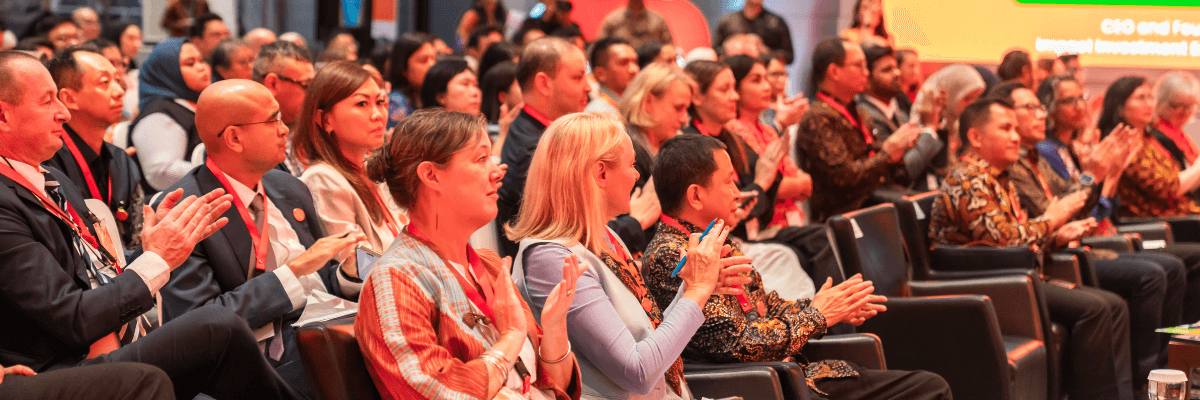
The movement continued to accelerate and the momentum extended across the region. Vietnam had surpassed the global average on the Orange Index™. Bangladesh’s Securities and Exchange Commission had formally recognized Orange Bonds. Japan’s ITOCHU Corporation had issued the country’s first Orange Bond. The question for other markets is no longer if, but when.
Prof Durreen Shahnaz also announced IIX’s ambition to establish a $1 billion Orange Fund, anchoring a wider call to mobilize $10 billion by 2030. She urged participants not to treat the Forum as ceremonial but as a platform for commitments and action.
“This is no longer a story of investing in emerging markets. It is a story of learning from them,” she said. “Our markets, our women, our entrepreneurs, our communities are defining a new measure of value, one grounded not only in returns, but in resilience, equality, and hope.”